
ESCUELA ARBITRAL DE AJEDREZ
Our opening class: From the regulations to sound judgement
31 October 2026
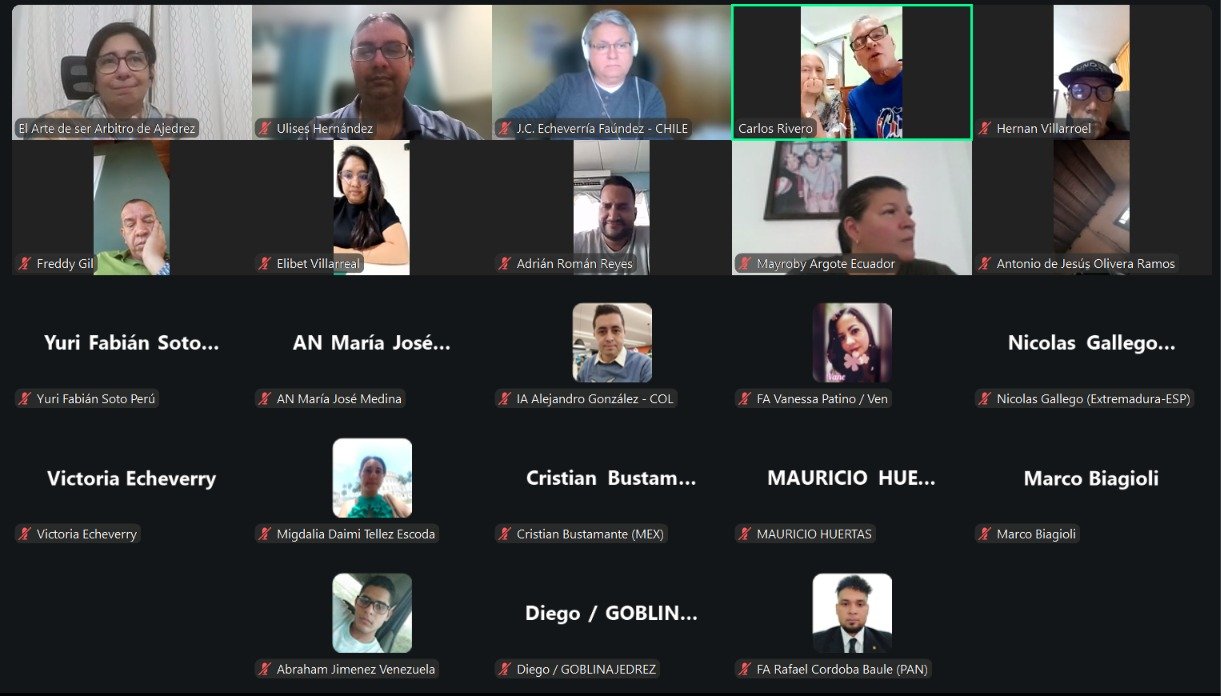
Can an upside-down rook stand for a queen? What must the arbiter check before deciding a draw claim? Questions like these opened the School’s first class, From the regulations to sound judgement, on 6 November 2026. Around 30 people from 14 countries joined the Zoom session taught by Bárbara Isabel López-Chávez Mariño, International Arbiter and FIDE Lecturer.
Participants joined from Algeria, Argentina, Bolivia, Chile, Colombia, Cuba, Ecuador, Spain, Honduras, Italy, Mexico, Panama, Peru and Venezuela.
From the board to the decision
The practical section, “Now you decide”, presented an unusual promotion. White announced a queen, placed an upside-down rook on the last rank and pressed the clock. Black claimed a draw. The exercise required reconstructing the sequence and distinguishing what the player announced, what was placed on the board and what the opponent claimed.
In another case, a player wrote down her next move and called the arbiter to claim a draw by threefold repetition. The question was precise: would the same position appear for the third time? The side to move and the possible moves, including rights such as castling, matter under Article 9.2.
The class also considered a move made with both hands and a touch-move claim with conflicting accounts and no witnesses. In the first case, it matters whether the clock was pressed (Article 7.5.4). In the second, the arbiter must establish what facts can be determined. Consult the FIDE Laws of Chess ↗.
From an indication to evidence
The fair-play section considered a mobile phone hidden in a toilet, with indications pointing to a player. What steps should the arbiter take to establish the facts before deciding whether a penalty was appropriate? Another exercise considered what a player should check in the tournament regulations when wishing to appeal a decision.
When the software cannot complete the pairings
The class materials included a case from the European Club Cup in Budva. After round four, Swiss-Manager could not complete the fifth-round pairings. The arbiters reviewed the problem and, after entering one key pairing, the program completed the remaining pairings. The session left a question to take home: could you check a pairing without relying on the program?
Opening class · Zoom · 6 November 2026.
Review the first class in the virtual classroom
The slides and exercises for the class on 6 November are listed with its recording in the classroom.
Open the slides and exercises (class materials in Spanish) →
To everyone who joined our first class: thank you for sharing the beginning of the School with us.